Saturday, September 11, 2010

THERE IS AN ALTERNATIVE - AND THEY KNOW IT!


This article was taken from Mary Lou McDonald's Blog. A blog which is always well worth a read.

http://maryloumcdonald.blogspot.com/

There is an alternative to this rotten government


Each year Sinn Féin presents to government the party’s pre-Budget submission. As Ireland’s fortunes have changed significantly over the last two years December’s budget has become an important day of the year, particularly for the least well off in our society as they face cuts in critical supports and services and the double whammy of an increase in inequitable stealth taxes.

Fianna Fáil and the Progressive Democrats’ right wing agenda coupled with their fiscal recklessness during Ireland’s boom years hardened the collapse of our economy. The Green’s have compounded the states public finance deficit and double-digit unemployment figures by signing off on Fianna Fáil’s golden circle policy approach. Or maybe they have just found their political home in a Fianna Fáil led government!

Fianna Fáil was so beholden to those within it golden circle it decided to nationalise the worst bank in the history of the state. Anglo Irish Bank has cost the Irish people 22 billion euro to date with rating agency Standard Poor’s recently estimating that the total cost of bailing out the bank will rise to 35 billion euro.

But it is not enough for those of us in political opposition to bemoan the horrific failings of this government; we need to present our political and fiscal alternatives to the people. And that is what we in Sinn Fein have done each year with a particular focus on job creation since the collapse of the economy in 2008. We are currently working on our Budget 2011 submission, which will be published and submitted to government in advance of budget day on December 7th.

Click on the below links to download Sinn Féin Job Creation strategy document and our 2010 Budget submission to government. In these document’s you will find sensible viable alternatives to the government’s budget decisions including a range of tax revenue measures and proposals to address wasteful spending of public monies.


Westminister's Decades Long Campaign to defeat Nationalism

The Tory and Labour Governments of Westminister have waged a decades long struggle to defeat nationalism: Scottish nationalism.

BBC Alba covers the many tricks, strategems and mistruths employed by Westminister to keep the union intact.

Only our Scottish comrades could provide comment on this but I wonder have the english language BBC ever ran such a documentary - a documentary on how the UK govt. lied to the Scots.

I think of RTE and the contrasting example of TG4 which ran that fantastic series on prison breaks, including the Great Escape. RTE could never, would never (in its current form) run such a broadcast.

Its a 6 part series but worth a look.


Thursday, September 9, 2010

The local economy - relying on We Ourselves rather than the Government.

The underwhelming approach of the Government continues to damage sth Ireland terribly. Brian Cowen may believe the spiking of the interest rate on 10-year Irish bonds to over 6% - Greek style rates was a blip. Its not. Its how lenders view our long term ability to repay debt and a vote of no-confidence in the Govt. handling of the crisis. Commentators from every quarter are now bemoaning the economic failures of the Dept. of Finance who are changing the plans again for Anglo Irish. We wont even know the full cost of the Anglo Irish bank crisis until next month. A never ending evasion of responsibility,  especially to Leinster house and tax payers as noted by Arthur Morgan. Brian Lenihan said the high yield rates were a result of our transparent policies. The tax payers never sees those transparent policies. 
 
So what does all this mean in real terms. By 2013 for every 4 euros to spend on the economy 1 euro will be spent on interest payments abroad 
 
For those of us still working one day a week will be worked not for the benefit of the Irish economy but to pay for the Developers and Fianna Fail's gambling.
 
As has been noted in many places we will need to raise our levels of production. We need to get people off the dole ques and into jobs. The scale of the task is huge  - hundreds of thousand of jobs lost must be replaced.
 
How are we going to do this? Well there are job creation strategies put forward but not implemented by Fianna Fail and additionally there are good ideas on helping young entrepreneurs strategies bring jobs back into local communities.
 
Look at Munster Rugby who now gets all its juice shakes from a small local company in Limerick. A small company employing 6-7 people set up by a man who gained experience with multi-nationals and used that experience to create jobs in rural Ireland. Jobs that dont depend on decisions made in America or wont relocate at the drop of a hat.
 
Instead there has been a Govt. led over-reliance on the promise of multi-nationals, to the neglect of more balanced development of the economy, and the high value knowledge economy. The problem with this is jobs from medical devices, financial services, digital media etc will be overwhelmingly urban based and likely to cluster around the largest towns and cities. Large swathes of the countryside will remain in economic decline.
 
Boosting the rate of young entrepreneurship will be a valuable way of getting jobs into small towns, the country side and housing estates which may be left behind. It will help to stem the decline of rural Ireland and revitalise urban Ireland.
 
Back in 1995 an academic from Galway University published a paper called "Desertification: Measuring population decline in rural Ireland". My own local region was one of those communities marked for a slow painful death  - we were just far enough away from the major urban centers to be isolated rather than included.  
 
The Celtic Tiger didnt solve the problems of rural decline and economic imbalances - it papered over them. The Celtic Tiger didnt end poverty in Ireland - it simply ignored it. Witness the recent report on poverty by the ESRI:16% in 2007 - before the bubble burst. A fifth of young children at risk of falling below the breadline with 7pc of them in consistent poverty.

Even harder for  lone parents - "In 2004, children in lone parent families accounted for 53pc of children in consistent poverty, while in 2007, 65pc of children in consistent poverty were in such families". But lone parents in the south are excluded from the economic life of the stated by an Irish childcare system thats not fit for purpose despite a decade to make it so.

How many skilled young people will emigrate and create good jobs in other countries. How many would stay here and create those jobs in rural and urban Ireland if given the support and opportunity to create new businesses - the type of support laid out by Sinn Fein. Businesses which would save local communities from dying, and help the most marginalised in Irish society share in any future economic growth.
 
Fianna Fail should view the emigration of every Irish worker not as one less dole payment but six less jobs.
 
Fianna Fail's mindset is the mindset of the past. In order to save our communities the electorate must consign them to them past.

Tuesday, September 7, 2010

Raising the Red Flag at the Rotunda. The workers occupation of January 1922.

The seizure of the Rotunda concert hall by a reasonably large group of unemployed workers, and the hoisting of the red flag over the premises, remains one of the most bizarre and understudied events of the Irish revolutionary period.

The story of this event is enjoyably recounted on the Come Here to Me website which covers the political, social, and radical history of Baile Atha Cliath. The article is reproduced with the kind permission of the author. Go raibh maith agat Donal.

The seizure of the Rotunda by unemployed people had as one of its leaders a man called Liam o'Flaherty who like many unemployed was in an Irish unit of the British army in WW1 before entering radical left politics, the Citzen Army and eventually seeing action with the anti-treaty forces in the civil war. 

In his excellent history of the ITGWU, The Irish Transport and General Workers’ Union: The Formative Years C. Desmond Greaves wrote that, early in 1922 “….industrial conflict took the form of individual struggles rather than a concerted class war.” The occupation of the Rotunda came two days after the foundation of the new state, and was perhaps the earliest example of class anger within it, a direct response to the existing high levels of unemployment. One of the leading figures of this occupation was Liam O’ Flaherty, today well-known as the author of The Informer, the classic novel, but then acting as a dedicated socialist.

He, like so many other unemployed men in Dublin, had served in the Great War, serving with the Irish Guards. He had been on a strange journey before returning to Dublin, and Emmet O’ Connor notes in Reds and the Greens that “After being invalided out of the British Army he set off trampling about the Mediterranean and the Americas, joining the Wobblies in Canada and the Communist Party in New York. He returned to settle in Ireland in December 1921….”

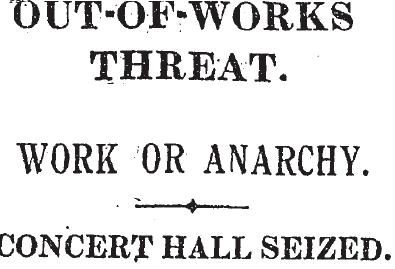
On January 18 1922, a group of unemployed Dublin workers seized the concert hall of the Rotunda. The Irish Times of the following day noted that:

 “The unemployed in Dublin have seized the concert room at the Rotunda, and they declare that they will hold that part of the building until they are removed, as a protest against the apathy of the authorities.”
“A ‘garrison’, divided into ‘companies’, each with its ‘officers’ has been formed, and from one of the windows the red flag flies”

Liam O’ Flaherty, as chairman of the ‘Council of Unemployed’, spoke to the paper about the refusal of the men to leave the premises, stating that no physical resistance would be put up against the police and that the protest was a peaceful one, yet they intended to stay where they were.

“If we were taken to court, we would not recognise the court, because the Government that does not redress our grievances is not worth recognising” O’ Flaherty told the Times.


A manifesto was issued by the occupiers, the first publication of O’ Flaherty. O’ Connor notes in his study that “Their manifesto was O’ Flaherty’s first publication. One could say that Phelan (A reference to a CPI comrade of O’ Flaherty, Jim Phelan) was impressed. ‘It’s language has not, I think, been approached since the days of the American War of Independence and the first French Revolution’ “

A later Irish Times report gives some idea of the level of organisation involved in such an occupation. On January 20 the paper noted that a man had been court martialed and reduced to the ranks. “…we reduced him to the ranks for disobeying orders” the paper quoted the “leader of the men” as saying. By that stage, two days into the occupation, around 200 men were present.

The paper noted a maintainance fund had been established, with Bolands bakery on Capel Street making a grant of 500 loaves to the men. The paper also noted that sporadic concerts had taken place inside the occupation, and that “A meeting of the unemployed was held during the day yesterday, and the “garrison” paraded Parnell Square”.

Of course, many Dubliners were extremely hostile to the sight of the red flag in Dublin. Angry demonstrations occurred each night during the occupation, and the Irish Independent noted (January 21) that “About 8.30 last night a hostile crowd of about 500 assembled in Cavendish Row, and indulged in shouts and derisive cheers. About 10pm a young fellow made an attempt to reach the red flag hung out from a window, but fell to the ground. He was taken to Jervis St. Hospital, but he was not detained.” When the flag was removed, the crowd cheered loudly.It was only thanks to the Dublin Metropolitan Police and the Republican Police that those inside the Rotunda were unharmed, as the crowd stormed the building. It was becoming clear the occupation was not sustainable. On the Thursday night, a member of the occupying group had been attacked collecting money near the premises, and since then tensions had been high.

The occupation, which had begun on Wednesday, was to end late on Saturday night. As the hatred outside intensified, shots were fired over the heads of the mob from inside the hall. Just before midnight, and under the protection of the combined police forces, the occupiers left the building and the crowd soon departed without incident. O’ Flaherty took off for Cork.

The Gate Theatre, site of the occupation today.

O’ Flaherty would later fight in the Irish Civil War, one of the socialists present in Vaughan’s Hotel, a republican seizure of note owing to the fact it was a favourite meeting place of a certain Michael Collins during the War of Independence! O’ Flaherty is not the only Irish writer of note to have partaken in the Civil War of course, with Sean O’ Faoláin just one other example. The early parts of 1922 saw much industrial unrest, and a number of creameries in the south of Ireland were sized in May. Greaves noted in his prior mentioned study of the history of the ITGWU that the Labour Party and TUC had attempted to “…ensure the neutrality of the Citizen Army by incorporating it into a ‘Workers Army’ that would cover the whole country….But no army can fight for neutrality, and the project soon fell through”

Still, the physical battles between two armed factions and the class conflict remained more or less disconnected from one another. An editorial in the Workers Republic, printed on July 22 1922, noted
“What will attract the masses to support the Republicans? At present, they cannot see any benefit in fighting for it! At present the Free State offers them more economic and social advantages. At the moment it seems as if the Labour Party, representative of the masses, can find its salvation in the Free State rather than in the Republic”

Liam Mellows, perhaps the republican figure who fought hardest for republicanism to add a real social dimension to its goals, was to be executed in a hail of bullets. His now famous prison notes noted that “In our efforts now to win back public support to the Republic we are forced to recognise whether we like it or not- that the commercial interest, so-called, money and the gombeen men are on the side of the Treaty”

The occupation of the Rotunda remains an often overlooked piece of the history of the period. Before Mellows penned the above, O’ Flaherty and a small band of followers had demanded a Workers Republic, and nothing short thereof. In Irish history, the Rotunda is seen as being of great importance as the site of the foundation of the Irish Volunteers. Sadly, no plaque marks the workers occupation of the site in 1922.

Sunday, September 5, 2010

Euskadi Ta Askatasuna announce ceasfire


Responding to a call made last Friday by the Basque political parties Batasuna and Eusko Alkartasuna, ETA has announced a new initiative to resolve the conflict in Euskal Herria. 

In a statement spokespersons for ETA confirmed "its commitment to finding a democratic solution to the conflict". 

"In its commitment to a democratic process to decide freely and democratically our future, through dialogue and negotiations, Eta is prepared today as yesterday to agree to the minimum democratic conditions necessary to put in motion a democratic process, if the Spanish government is willing,"

"We call on all Basque citizens to continue in the struggle, each in their own field, with whatever degree of commitment they have, so that we can all cast down the wall of denial and make irreversible moves forward on the road to freedom."

Commenting on the Basque Ceasefire events Gerry said 'This is a significant statement and has the potential to bring about a permanent end to the long-running conflict in the Basque country. Its now vital that the Spanish government respond positively and grasp the opportunity'.

There is a regrettable mindset in Spanish political circles which believes that the more people they imprison or the more activists like Jon Anza who disappear only to reappear after many months in a morgue then the more progress is made in resolving the conflict.

They are wrong. The only way forward is inclusive political negotiations. Lets hope they take that step. 

Wednesday, September 1, 2010

An unbroken chain - The escape of Vol. Tom Malone from Spike in 1921

At age 8 Tom Malone from Westmeath stood on a land league platform with Davitt. His mother was dismissed  from her school job for teaching Irish. He was out in 1916, and went on to become a key Volunteer in the Tan war and throughout the 30s. In 1921 Vol. Tom Malone and two comrades audaciously escaped from Spike Island, becoming the first to do so.

As we approach the 27th anniversary of the Great Escape planned by Volunteers in the north of our country it is fitting to consider 3 volunteers in the south of our country who performed an equally daring escape.

An unbroken chain, an unbroken tradition, linking many generations in one continous struggle.

The story of Tom Malone
Video Part 1 
Video Part 2:

Video Part3:

Limerick - One story but indicative of whats happening across Rural Ireland.

Just read this on Breakingnews and for me, just like the Seamus Sherlock story, it sums up how rural Ireland is going to be doubly battered - by the recession and the Govt. response.  

"A Limerick man has had to close his family business of 121 years and emigrate to Australia because of the recession and is adamant that he will never return to Ireland.

Forty-seven-year-old Declan Murphy has said he was forced to close Murphy and Son Menswear in Newcastle West - a business which first opened its doors in 1889.

1889 is one year before Michael Collins was even born. Minister of Finance Brian Lenihan is a student of history. He should appreciate that while that business survived land wars, world wars, guerilla war and civil war it didnt survive his administration.

Father of three Declan Murphy said he can no longer support his family with the business and has made the difficult decision to emigrate."
Both Rural and Urban Ireland are going to get it in the neck. I am not saying its better in one place or the other. Rural and Urban Ireland will be affected in similar and also different ways. A town smaller than Newcastle West may not have the critical mass required to even launch new shops and establish alternative providers, that large population centers will have. Larger population centers may well have the critical mass but they too will face unique problems and hardships associated with an urban context.

NewcastleWest town has a population of about 11000. In the Social Welfare office in the town there are 3,739 people now registered - people from the town and its wider economic hinterland. This is replicated across rural Ireland - urban centers being stripped of amenities and services while their hinterlands enter into a particularly severe economic decline.

Its sad to think that soon in rural Ireland there will be many towns with no post office, no bank, no clothes shops, no jobs and no amenities, even no Gaelic football teams, no hospitals nearby. The sheer breadth of the assault being carried out on rural Ireland is awe inspiring. The last budget also targetted rural Ireland harshly.

During the Tan War the enemy army tried to destroy rural areas of resistance by burning towns and destroying centres of economic activity - to break the backbone of small communities. They didnt succeed but Fianna Fail might just - they have a lot done and more to do.